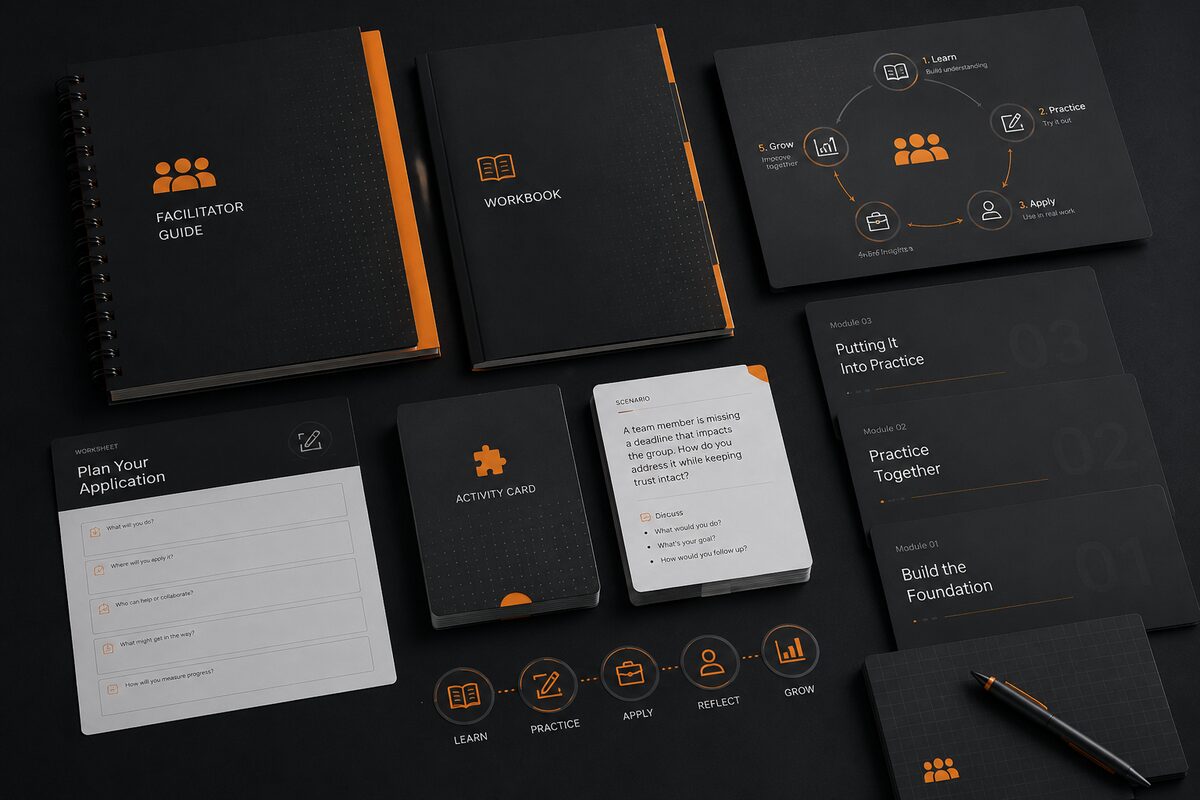
You can run a polished training session, tick every slide, and still watch most of it evaporate by the following week. The problem is rarely the content. It is that the material was built to be shown, when it needed to be built to be practised. Here is how to design training people still use once you have left the room.
Start from what they should be able to do
Before a single slide, write the one sentence that matters: "after this, someone should be able to ___." Not "understand" or "be aware of" — do. Every section then earns its place by moving people toward that action. Anything that does not is interesting, not essential, and it is the first thing to cut.
Build around doing, not showing
People remember what they did, not what they saw. So the spine of good training is not a deck — it is a sequence of small, safe attempts.
- Show one clear example, fully worked.
- Hand them a near-identical one to try themselves.
- Then a slightly harder one, with less scaffolding.
That "I do, we do, you do" rhythm is what turns watching into ability.
Give it two layers: facilitator and participant
Training material that travels has two versions. The facilitator guide carries the timing, the talking points and the answers. The participant workbook carries the exercises and just enough reference to work from. Split them, and anyone can run the session — including the client, months later, without you in the room.
Design attention, not just information
A slide with fourteen bullets teaches nothing; people copy it down and stop listening. One idea per slide, plenty of space, and a clear signal for what matters. Let the workbook hold the detail so the screen does not have to.
Build the handover, not just the day
Most training is designed for the event and forgotten the moment it ends. Build for the week after instead: a one-page recap they can pin up, a checklist for the task, a short "what to do when you're stuck" note. The goal is not a good session. It is a changed behaviour that survives without you.
Want this built for your team? See the learning materials service or start a project.