Most small business websites are doing far too much. Pages nobody visits, plugins nobody uses, a monthly subscription to keep it all limping along, and an owner who is nervous to touch it in case something breaks.
Here is the thing almost nobody says out loud: your website has one job. Tell people who you are, what you do, and how to reach you, quickly and clearly. For most small businesses, that is the whole job. Everything else is decoration, or worse, friction.
What a small business site actually needs to do
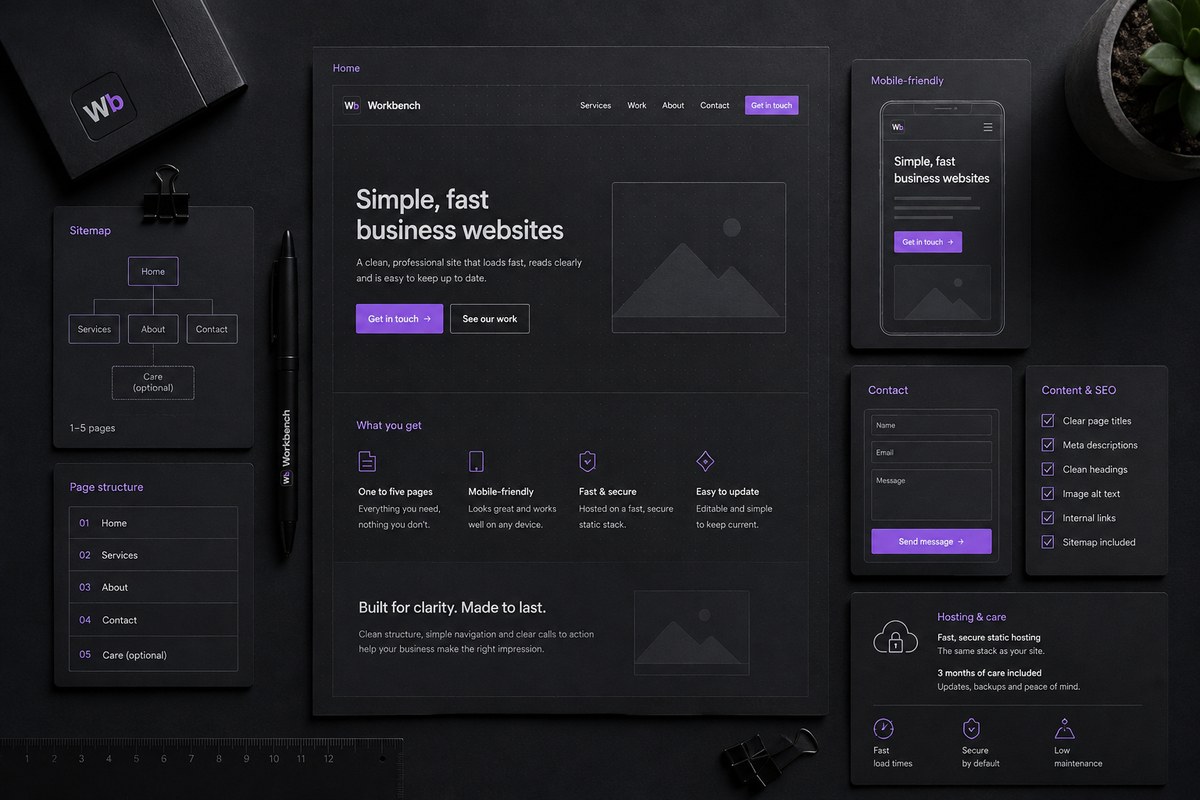
Strip it back and the list is short. Load fast, so people do not leave before it appears. Say what you do in about five seconds. Work properly on a phone, because that is where most people will see it. Make it obvious how to get in touch. And be findable, which is just a handful of SEO basics done right: clear titles, sensible descriptions, a sitemap.
That is a site that works. Notice what is not on the list: a blog you will never update, a slider nobody reads, fourteen plugins, or a page for every thought you have ever had.
Why simple beats complicated
The usual small business site is built on a heavy page-builder, stacked with plugins, sitting on middling hosting. It looks fine on day one. Then it slows down, something breaks after an update, and changing a phone number turns into an afternoon. And it quietly costs a subscription every month to keep limping along.
A simple, static site is the opposite. There is no heavy machinery to slow it down and nothing bolted on to break. It loads fast, stays secure because there is very little to attack, and costs almost nothing to host. Fewer moving parts is not a compromise here. It is the entire advantage.
Simple does not mean plain
This is the part people get wrong. Simple is not a smaller budget or a worse design. It is a decision to do a few things properly instead of many things badly. A clean, confident site on your brand, that reads clearly and loads instantly, looks more professional than a busy one straining to impress. Restraint reads as confidence.
And you should own it
A good small business site should be yours. Your domain, your hosting account, and editable files you keep, so you are never locked into one person or one platform. If you move on, the site moves with you.
That is how I build them: clean, fast sites on secure static hosting, one to five pages, done properly and kept simple. Not because it is all a small business can afford, but because it is what a small business actually needs.